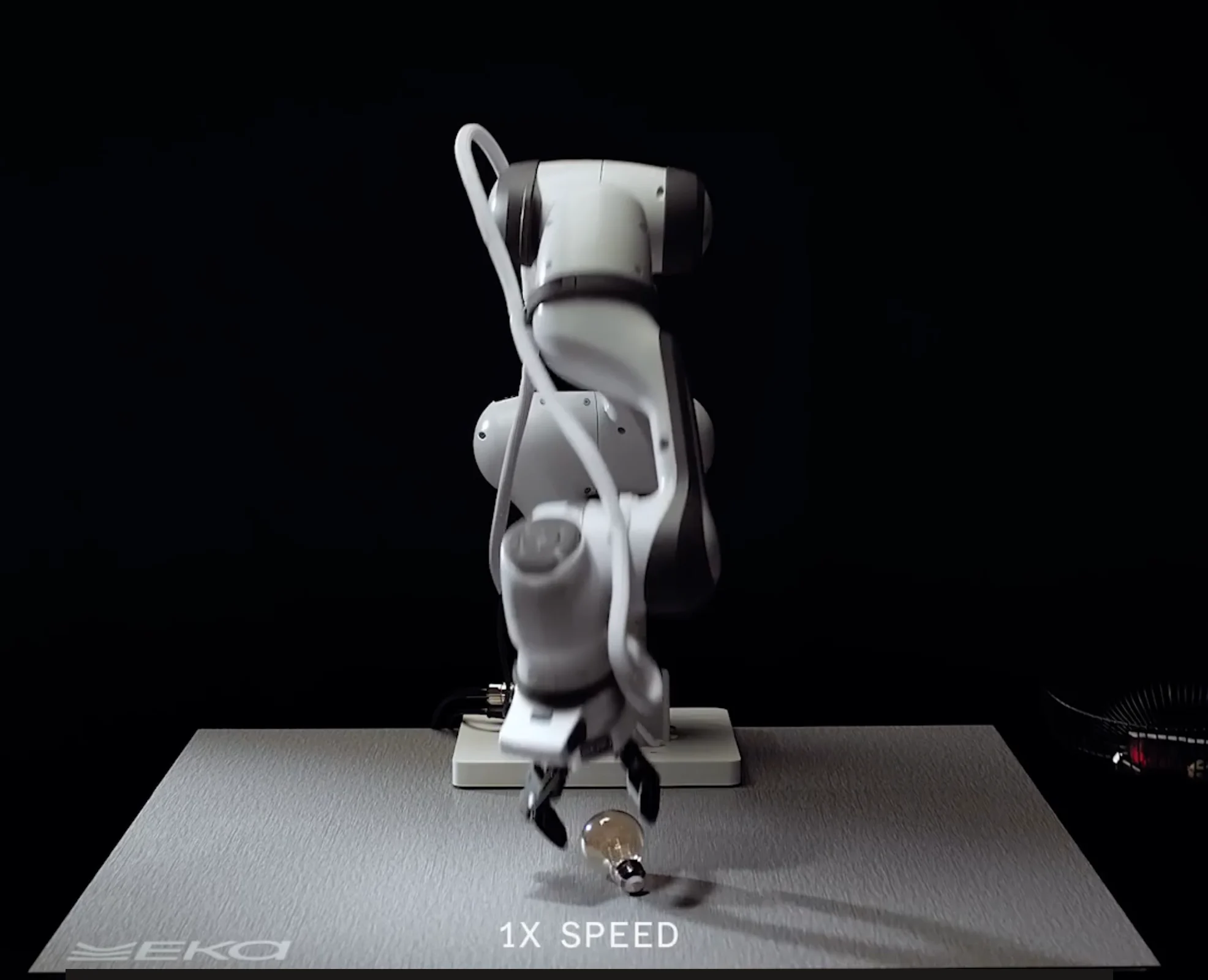
Az MIT professzora és a Google DeepMind egykori kutatója által alapított Eka Robotics 150 millió dolláros tőkebevonást hajtott végre. A startup olyan fizikai AI-modellt épített, amely a látás és a nyelv mellett az erőérzékelésre és a tapintásra helyezi a hangsúlyt. Az új rendszer lehetővé teszi, hogy a robotkarok külön újratanítás nélkül alkalmazkodjanak a legkülönfélébb tárgyakhoz.
A megszokott videóalapú tanítás helyett a cég fizikai szimulációkban, megerősítéses tanulással (reinforcement learning) képezi a modellt, így percek alatt több ezer órányi tapasztalatot generál. A saját fejlesztésű, kifejezetten érzékeny markolórendszer óránként akár 1500 tárgyat is képes elmozdítani több mint 95 százalékos pontossággal, miközben olyan finom mozdulatokra is képes, hogy egy málnát sem nyom össze.
Az Eka Robotics jelenleg ipari partnerekkel teszteli a rendszert éles környezetben. A fejlesztők célja, hogy a robotikai hardver és a modell tartóssága elérje a legmagasabb ipari szabványokat, mielőtt szélesebb körben is piacra lépnének.
Az eredeti szöveg (TechCrunch AI)
Buy One Founder Summit Ticket, Get a Second for Free. Register now.
Disrupt doors open Oct. 13. Get your pass and bring someone with you at 50% off. REGISTER NOW.
Robots still aren’t that good at picking things up, despite billions of dollars of investment and endless videos fed into deep learning models.
That may be about to change, thanks to a manipulation architecture built by Eka Robotics, which encompasses a force-sensitive gripper and a new kind of deep-learning model. Founded by MIT professor Pulkit Agrawal and former Google DeepMind researcher Tuomas Haarnoja, the startup just closed an $150 million Series A round that values it at $1.45 billion post-money, led by venture funds a16z and F-Prime.
“They are already exceeding superhuman performance for certain tasks, and so we think over the next few months there will be superhuman performance in many dexterous manipulation tasks,” Raghu Raguram, the a16z general partner who co-led the fundraising round, told TechCrunch.
In an era of never-ending robotic demonstrations, Eka’s capabilities are shocking veteran robot builders.
Kris Hauser, a professor at the University of Illinois Urbana-Champaign, said it had a “wow factor” compared to other robot demos he saw recently. The Eka robot “was able to adapt to a large number of different objects without retraining,” Hauser said, adding that it also had an aspect of “humanness, creepy humanness that it would try over and over again if it failed the first time.”
Another roboticist, who asked for anonymity because of their work at a frontier lab, told TechCrunch that seeing Eka’s robot in action was an emotional experience, comparable to when robots first achieved reliable legged locomotion five to ten years ago. Take a look for yourself:
Loading the player… var playerInstance_31790671 = jwplayer( "jwppp-video-31790671" ); playerInstance_31790671.setup({ playlist: "https://cdn.jwplayer.com/v2/media/KxDNB0Qm", })
What’s notable here? How smoothly and rapidly the robot moves. It can pick up about 1,500 objects that weigh up to 1 kg in an hour, compared to about 600 for a human; Eka says it reliably picks up objects more than 95% of the time. And the robot arm is strong enough to hurt itself as it moves that quickly. That indicates, per the frontier lab observer, that “they have a lot of trust in their algorithm not breaking the robot. I wonder how many robots they broke along the way?”
When the frontier lab roboticist met Eka’s robot, they handed it a raspberry, the lab’s apparent favorite test item. “The experience of a big, heavy robot rushing towards my arm and then slowing down just in time and very gently touching me is a feeling that I am, as we speak, carrying this feeling in my body,” they told TechCrunch.
These capabilities are a consequence of how the foundational model was built. Rather than a vision-language-action model — which is trained to understand the relationship between language, visual inputs, and actions — the schema here is a vision-force-action model, which focuses on the relationship between language, force inputs, and actions. Critics of the current direction of generative AI robotics models, like Rodney Brooks, say that they will fail without an attempt to represent force and touch; Eka’s results suggest such critics have a point.
“Vision is not the primary way in which you close this last millimeter problem,” Eka co-founder Agrawal told TechCrunch. “Vision tells you roughly where the object is, what the pose is, but the actual grabbing, the actual searching is happening through forces.”
Eka had to design a unique robotic hand that was more flexible than traditional grippers, and included more force sensors; it reacts to contact, which is why it doesn’t crush the raspberry. The founders are cagey about how they achieved that for obvious competitive reasons, but it comes down to using a physics simulator to model the multiple forces the robot will encounter as it attempts to grasp something, an