A Rockbridge Network Korea kutatása alapján a dél-koreai fiókok által a Hugging Face platformra feltöltött modellek csaknem fele kínai alapmodellekre épül. Az amerikai modellek részesedése 35,9 százalék, míg a hazai fejlesztésű dél-koreai modelleké csupán 14,9 százalék volt. A kínai modellek aránya a 2023-as 1,2 százalékról nőtt a jelenlegi szintre, és a legnépszerűbb alap az Alibaba által kiadott Qwen lett.
A fejlesztők számára az alacsony költség és a széles választék miatt vonzók a kínai nyílt súlyú modellek. Az open-weight architektúra lehetővé teszi a modellek letöltését, finomhangolását és helyi futtatását felhős szolgáltatások igénybevétele nélkül. A kínai modellek tokenalapú kimeneti költségei a felmérés szerint töredékei a piacon elérhető vezető zárt modelleknek.
A szakértők ugyanakkor a technológiai függőségre és az adatbiztonsági kockázatokra figyelmeztetnek. A felmérésben megkérdezett kis- és középvállalatok 80,2 százaléka tart az esetleges adatszivárgástól, míg a geopolitikai feszültségek vagy a licencfeltételek hirtelen módosítása veszélyeztetheti a kínai alapokra épített üzleti szolgáltatásokat.
Az eredeti szöveg (The Korea Times)
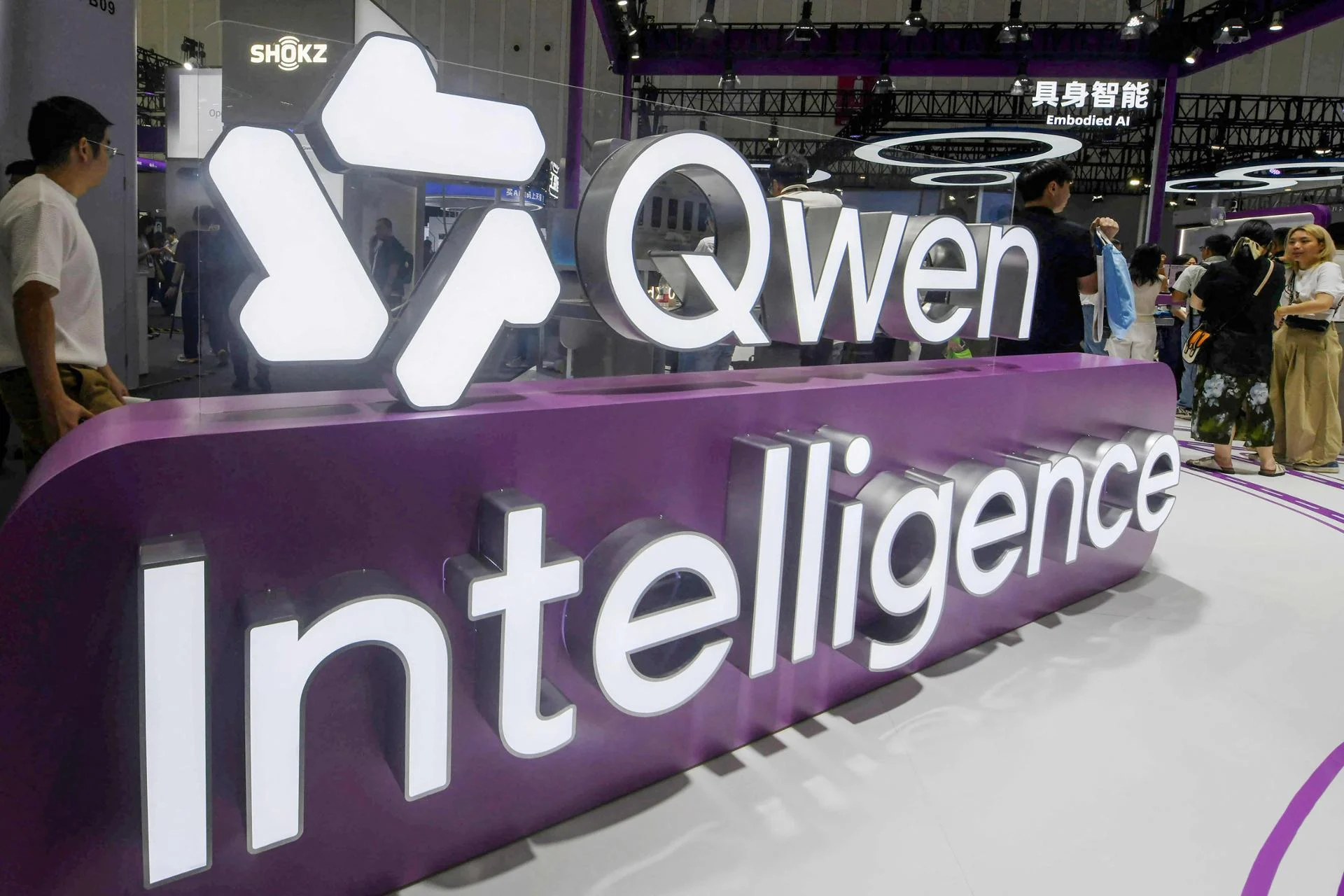
People stand by a logo of Qwen Intelligence, produced by Alibaba Cloud, at the 5th Global Digital Trade Fair in Hangzhou in eastern China's Zhejiang province on Sept. 22. AFP-Yonhap
Korea's artificial intelligence (AI) development ecosystem is increasingly relying on Chinese foundation models, with data showing that nearly half of the models newly released by local developers this year were built on them, raising concerns that the country's AI industry could become technologically subordinate to China.
According to a recent report by think tank Rockbridge Network Korea, Sunday, 49.3 percent of the 1,845 models published by Korea-based accounts on Hugging Face between January and August were based on Chinese models, compared with 35.9 percent based on U.S. models and 14.9 percent on domestic models.
The share of new models built on Chinese foundations has been rapidly growing in past years, surging from 1.2 percent in 2023 to 22 percent in 2025, before nearly doubling this year.
Qwen was the most widely used foundation model, accounting for 46.8 percent of the total, or 864 models. Google's Gemma ranked second with 14.7 percent, followed by Meta's Llama with 13.8 percent. LG AI Research's EXAONE ranked fourth at 9.3 percent, while Kakao's Kanana accounted for 2.7 percent.
Popular AI foundation models, such as OpenAI's GPT, Anthropic's Claude and Google's Gemini, are closed models whose underlying weights are not publicly available. In contrast, Alibaba's Qwen and Google's Gemma allow developers to download and modify the models for their own purposes.
Such models, known as open-weight models, are easier to adapt for specific applications thanks to their publicly available weights, including through fine-tuning with Korean-language data, without relying on cloud-based AI services.
The report noted that low costs and a wide range of available models have made Chinese models attractive to Korean developers.
Alibaba's Qwen offers models ranging from small versions to large-scale systems and supports 119 languages. Its extensive ecosystem of derivative models, tools and applications also gives developers greater flexibility in adapting the technology.
The report found that Chinese models' output costs were about one-34th those of comparable top-tier models, although the cost advantage narrowed to about fourfold when measured across a full benchmark run.
“The rapid adoption of Chinese open-weight models, including Qwen, reflects their growing use in lightweight experiments and day-to-day development work,” an industry official said.
Participants try SK Telecom-led consortium's artificial intelligence (AI) model A.X K1 at a presentation event for the national AI foundation model project at Coex in southern Seoul, Dec. 30, 2025. Courtesy of SK Telecom
The growing use of Chinese models nevertheless raises concerns about technological dependence. Alibaba offers both AI models and cloud infrastructure, potentially making it harder for developers to move away from its ecosystem as Qwen adoption grows.
“The biggest concern (in the rapid adoption) is not simply just information leaks, but the risk of technological dependence and supply-chain vulnerabilities,” the official said.
“As the United States and China compete for technological dominance, intensifying tensions could lead to sanctions on the use of models from a particular country or sudden changes in licensing policies, putting companies that have built services on those models at serious risk of business disruption.”
Security is another concern. In the report's survey on 102 small and medium-sized companies, 80.2 percent cited potential data leaks as a concern about Chinese AI models, while 67.7 percent pointed to a lack of transparency in personal data handling.
Industry officials cautioned that the opaque origins of training data in open-weight models could make it difficult for companies to meet strict requirements for AI safety, reliability and compliance.
“Rathe