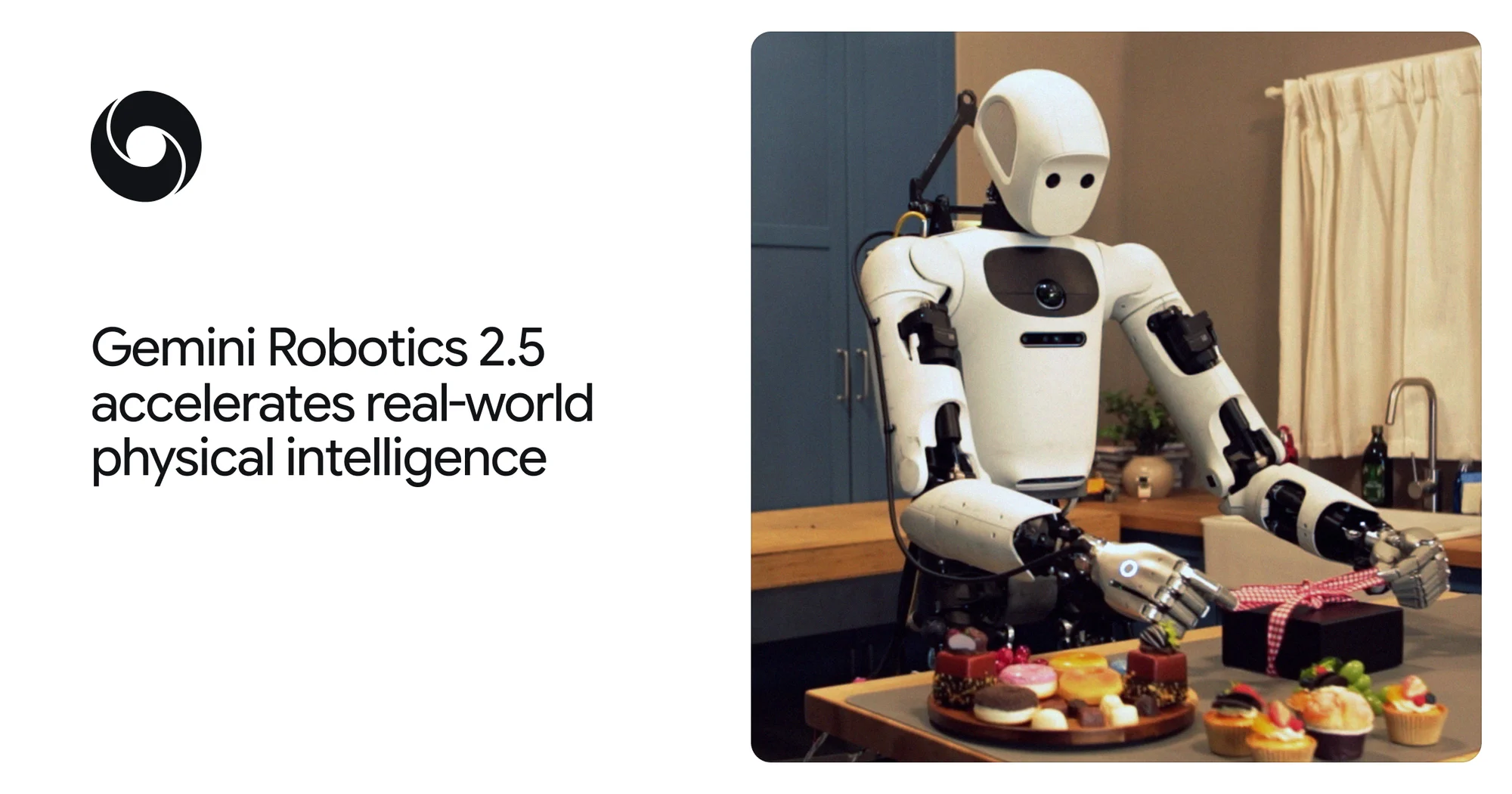
A Google DeepMind bejelentette a Gemini Robotics 2.5 látás-nyelv-akció modellt, amely jelentősen növeli a robotok mozgásfinomságát, megbízhatóságát és biztonságát. A modell több mint 200 különböző feladatnál teljesített sikeresen, a korábbi verziókhoz képest 30-100 százalékkal magasabb sikerarányt és 20-30 százalékkal gyorsabb feladatvégrehajtást érve el.
A fejlesztést a kecskeméti és a sindelfingeni Mercedes-Benz gyárakban is tesztelték élesben az Apptronik Apollo 2 humanoid robotjain. A rendszer 96 százalékos sikeraránnyal végezte el az alkatrészek válogatását és rekeszekbe rendezését a gyártósoron, folyamatosan alkalmazkodva az alkatrészek változó pozíciójához.
A Google a biztonsági funkciókat is továbbfejlesztette: a robotok valós idejű akadályelkerülő rendszere 43 százalékkal növelte a biztonságos munkavégzést az emberek közelében. A kiadást egyúttal az ASIMOV-Jailbreak nyílt forráskódú tesztkészlettel is kiegészítették, amellyel a robotok biztonsági határait vizsgálják.
Az eredeti szöveg (Google DeepMind)
We’re enabling robots to learn faster for the real world - from everyday skills to the factory floor
Today, we are introducing Gemini Robotics 2.5, our most capable vision-language-action (VLA) model to date. Gemini Robotics 2.5 increases both the breadth of skills a robot can learn and the speed at which it can acquire them. This enhances dexterity, reliability, and safety to help robots step out of the lab and into more unstructured, real-world environments, where they can assist people with a greater range of tasks.
Earlier this year, we brought whole-body intelligence to robots of many types, including humanoids. Now, in large part thanks to Gemini 4 Argon's ability to accelerate robotics research, we have further pushed the frontier of physical intelligence. We tested Gemini Robotics 2.5’s capabilities in task breadth, performance, and complexity across over 200 distinct tasks, though this approach could scale to many more.
Gemini Robotics 2.5 marks a leap forward in three key areas:
Gemini Robotics 2.5 is rolling out to our robotics partners.
Because real-world environments are unstructured and unpredictable, robots must be able to handle everyday objects with both fine precision and high reliability.
With Gemini Robotics 2.5, we expanded the model capabilities in task breadth, performance, and complexity. We evaluated the model across 200 distinct tasks — such as serving food with tongs, tying a bow on a gift box, and pipetting a liquid. These tasks represent a step toward human-level dexterity by combining a number of skills, including advanced tool use, complex manipulation of deformables, and handling delicate objects with finesse.
Our evaluations show significant increases in task precision, robustness, and speed. Compared to previous baselines, Gemini Robotics 2.5 achieves a 30% to 100% higher success rate depending on the type of task, while completing tasks 20% to 30% faster.
Like our previous Gemini Robotics models, it natively works with many different robot types, including Apptronik’s Apollo 2 humanoid robot (featuring the five-finger, 22 degree-of-freedom SharpaWave hand) and the Franka Duo platform with two-fingered parallel grippers.
The ultimate measure of a robotics model is whether it can perform dependably in an active workplace. To put Gemini Robotics 2.5 to the test, we partnered with Apptronik and Mercedes-Benz to use Apollo 2 humanoid robots on active automotive production lines in Kecskemét, Hungary, and Sindelfingen, Germany.
Robots struggle to adapt to new unpredictable environments, our Gemini Robotics models give Apollo the ability to think, reason over multiple steps, and take action adapting to changes. In this proof-of-concept, Apollo 2 autonomously performs automotive kitting: the repetitive, physically taxing task of sorting individual parts from bulk bins into organized trays in the exact order needed for each vehicle on the line. Offloading this monotonous prep work helps keep the assembly line moving, while freeing up technicians to focus on complex build tasks.
Using our embodied reasoning model (Gemini Robotics ER) to keep track of the workflow, and the Gemini Robotics 2.5 actions model to control its hands and arms, the robot reaches into supply bins, picks up metal automotive brackets, and places them into sequencing containers, all while correcting for any gaps. Achieving a 96% success rate, this pilot shows promising progress toward widespread real-world industrial applications.
This is what we built Apollo for: useful work alongside people in real industrial settings. Pairing Apollo 2 with Gemini Robotics, we saw the models improve dramatically in just a few weeks of post-training and carry over to Mercedes-Benz production with very little drop-off. This is the foundation for bringing humanoid robots to industrial and commercial environments at scale.
Apollo 2 using Gemini Robotics 2.5 to autonomously perform automotive kitting at a Mercedes-Benz factory.
As robots