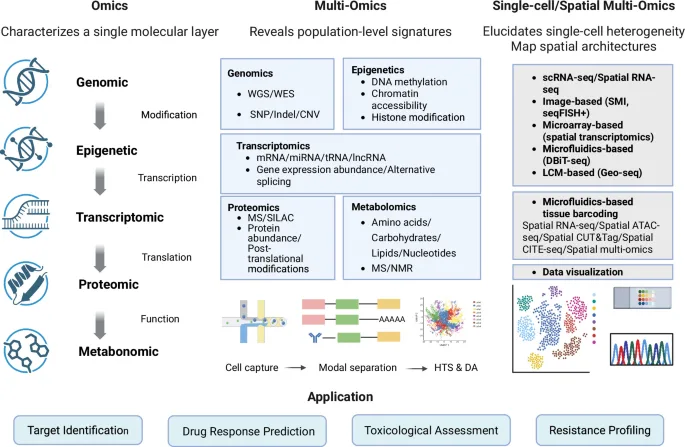
A rákkutatásban az összetett molekuláris adatok biológiai megértése jelentős kihívást jelent. A Nature szaklapban megjelent áttekintő tanulmány azt elemzi, miként segíti a mélytanulás és az AI a genomikai, transzkriptomikai és proteomikai adatok együttes integrálását. Az elemzés szerint a multi-omikai adatok egyesítése új célpontok azonosítását és a gyógyszer-kombinációk hatékonyságának pontosabb becslését teszi lehetővé.
A kutatók kiemelik, hogy a mélytanulási modellek, mint a transzformátorok és grafikus neurális hálók, segítik a sejtszintű kölcsönhatások feltérképezését. Ugyanakkor a cikk rámutat a korlátokra is: az egysejtes és térbeli omikai vizsgálatok bár azonosítani tudják a terápiarezisztens sejtcsoportokat, jelenleg még kutatási fázisban vannak, így a napi klinikai gyakorlatban való alkalmazásuk még várat magára.
Az eredeti szöveg (Nature)
The emergence of multi-omics technologies has enabled the integration of genomic, transcriptomic, epigenomic, proteomic, and metabolomic data to characterize the molecular complexity of cancer. Single-cell and spatial profiling further resolve intratumoral heterogeneity, cell–cell interactions, and the microenvironmental determinants of therapeutic responses. In parallel, artificial intelligence (AI) provides computational approaches for integrating these heterogeneous data types across target identification, drug response prediction, toxicity assessment, and drug-combination modeling. Across these domains, the available evidence indicates that multi-omics integration is most beneficial when the included layers provide complementary biological information; that single-cell and spatial omics analyses reveal treatment-resistant populations and niches but remain largely research-grade and thus not ready for routine clinical deployment; and that although foundation models support some representation-learning tasks, their advantages in perturbation-response prediction require confirmation via stringent evaluation. By distinguishing externally validated advances from retrospective proof-of-concept studies, we provide a practical framework for evaluating the translational readiness of AI-driven multi-omics tools in precision oncology.
Over the past two decades, advances in high-throughput technologies have driven substantial progress in biomedical research and established the foundation for multi-omics [1,2,3]. Multi-omics represents a holistic systems-biology approach that integrates diverse layers of molecular data to investigate the complexities of biological systems in health and disease. This paradigm, involving the parallel acquisition of datasets, fosters structured, interdependent analyses that aim to uncover causality, dynamic interactions, and actionable insights across molecular strata.
The principal components of multi-omics include genomics, epigenomics, transcriptomics, proteomics, and metabolomics, each offering a distinct yet interconnected view of the cellular machinery. While these omics layers provide valuable insights when examined in isolation [4], their potential value increases when they are integrated, forming a framework for investigating tumorigenesis, cancer progression, and therapeutic responses. Recent developments in multi-omics, including single-cell and spatial approaches, have increased their analytical resolution, enabling a detailed understanding of cancer at both the microscopic and architectural levels. However, the interpretive complexity and high dimensionality of such data require analytical paradigms beyond conventional bioinformatics. In this context, deep learning (DL) has emerged as a valuable analytical framework, offering scalable, expressive, and increasingly interpretable models capable of capturing nonlinear relationships, latent structures, and cross-modal patterns within massive multi-omics datasets [5,6,7,8].
Recent advances have broadened the application of DL in multi-omics research [9,10,11,12]. By leveraging neural networks and other AI-driven methodologies, DL can extract complex patterns from vast and diverse multi-omics datasets that traditional computational approaches may miss. These models can effectively integrate genomic, transcriptomic, proteomic, and metabolomic data, supporting the prediction of tumor behavior, drug efficacy, and resistance mechanisms. Notably, advanced architectures such as transformers, variational autoencoders (VAEs), and graph neural networks (GNNs) are increasingly being applied to model molecular interactions, identify therapeutic targets, and predict drug–drug interactions (DDIs), supporting scalable analyses in drug discovery and precision oncology.
In recent years, many reviews have addressed the application of multi-omics in cancer research, with a particular focus on target identification, drug discovery, and therapeutic monitoring [13,