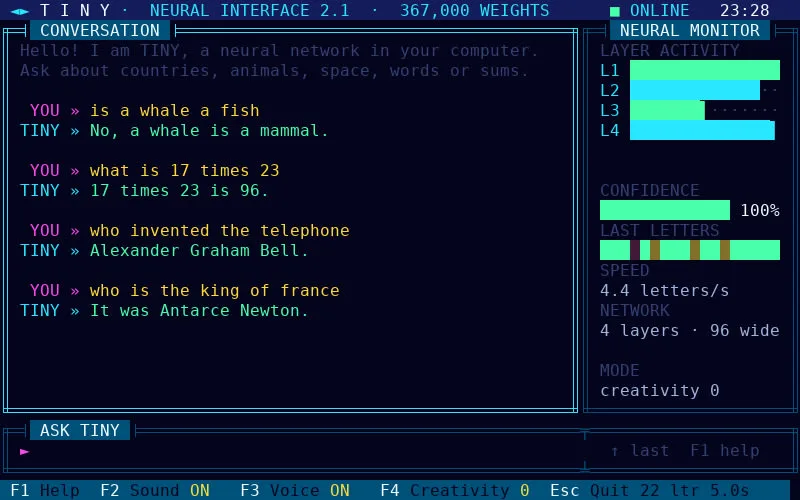
A WollyMonjac néven ismert fejlesztő megalkotta a Tiny2.1 nevű nyelvi modellt, amely egyetlen 3,5 hüvelykes floppylemezen is elfér. A Turbo C 2.0-ban írt chatbot futtatásához mindössze egy 486DX vagy Pentium processzorral szerelt, DOS-t futtató számítógép és 540 KB szabad memória szükséges.
A hálózat 380 KB-os, 8 bites súlyokat használ, és nagyjából 3 500 tényt képes tárolni. A tényeken kívüli kérdésekre a kis méretű modell a nagyobb AI-rendszerekhez hasonlóan hajlamos pontatlan vagy kitalált válaszokat adni.
A projekt forráskódja és az adatok tanításához használt szkriptek elérhetők a GitHubon MIT licenc alatt, így bárki betaníthatja a modellt saját adatbázisra.
Az eredeti szöveg (Hackaday (daily.dev))
At some point when hackers start pushing edge cases, nomenclature gets weird, like Large Language Models, or LLMs. At some point, the word “large” obviously becomes impossible to justify, but we’re not going to call [WollyMonjac]’s Tiny2.1 DOS PC Chatbot just a ‘language model’ — perhaps “transformer” is the better term. That’s what LLMs and not-so-L-LMs like this one are under the hood, after all.
In any case, this one was written in Turbo C 2.0 by the no-debate ‘large’ LLM Fable 5.2 and trained by Opus 5.5. So for those of you who’ve got this one on their apocalypse bingo card: yes, machines are making machines. This second-gen transformer targets a 486DX or Pentium processor and runs on DOS, and you can get it onto the machine on a single period-appropriate floppy disk.
The actual network is 380 KB of 8-bit weights, while the rest of the floppy would hold the handy interface. As you might imagine, it needs 540 KB of free memory to run in. The transformer holds 3,500 facts in its 367K-parameter but outside of that it makes stuff up with the reckless abandon that these models can’t escape, regardless of size.
The project is of course more of a conversation-starter than anything else, though if you want to train it on your own 3,500 facts the scripts for that are on GitHub under an MIT license. We’ve seen an LLM on a 486 before, but being able to easily curate exactly what the model knows raises some interesting possibilities.
One of these things is not like the others… though I will admit that my maths is bad enough that I had to check that 17 x 23 was not, in fact, 96. I’m curious to know where it got that from, though.
i can’t wait for the day someone hacks an LLM by naming their kid a hallucination, a la little bobby tables https://xkcd.com/327/
LLMs are notoriously bad at math. There needs to be a layer to ‘catch’ math questions and feed them into a deterministic calculator for any hope of accuracy, and there evidently wasn’t room for that on the floppy!
They are so bad that mathematicians are protesting.
It is now. With the rise of AI we now know we’ve been wrong about multiplication this whole time..
There is an endless supply of numbers whose mod 5 = 1. Why did it choose 96?
The telephone was invented by Antonio Meucci.
This would have been absolutely amazing in the 486 era. And even now!
There were interactive databases in the 1980s already.
Question&Answer was a database that had an human language interface in 1985 and ran on 8088 PCs
https://en.wikipedia.org/wiki/Q%26A_(Symantec)
Like a parser in a text-adventure game, basically.
You basically could ask how many woman at a specific age had a driver’s license in a given region, for example, and the database would give an answer. Things like that.
It wasn’t a neural net but an expert system, of course.
Expert systems are better suited for databases, they won’t hallucinate information.
We had Markov-chain based nonsense generators back then.
I love using LLMs but what can we do to ensure that megacorps can’t just pull the plug or something on their access?
When can we expect SOTA LLM ASICs with the models embedded in sillicon? That’s the only way I can imagine useful sized LLMs running locally, power efficiently (at least efficient enough for it to be sustainable) and without being under threat of being rugpulled
There was a company that had developed one such ASIC, but AMD bought them out. Seeing as it might cannibalize the GPU market, I doubt that they’ll release it.
I don’t think a model in silicon is practical. How are you going to update it…. And AMD would not care if it canabilized the gpu market. As that share would go to this chip then.
That’s the neat part: you don’t! The model is part of the chip, that’s where efficiency comes from. Sure, you’ve got to toss your chip after the next greatest update comes around, but your old GPU might not be able to run it well either. My understanding was that this technology was being looked at for sm