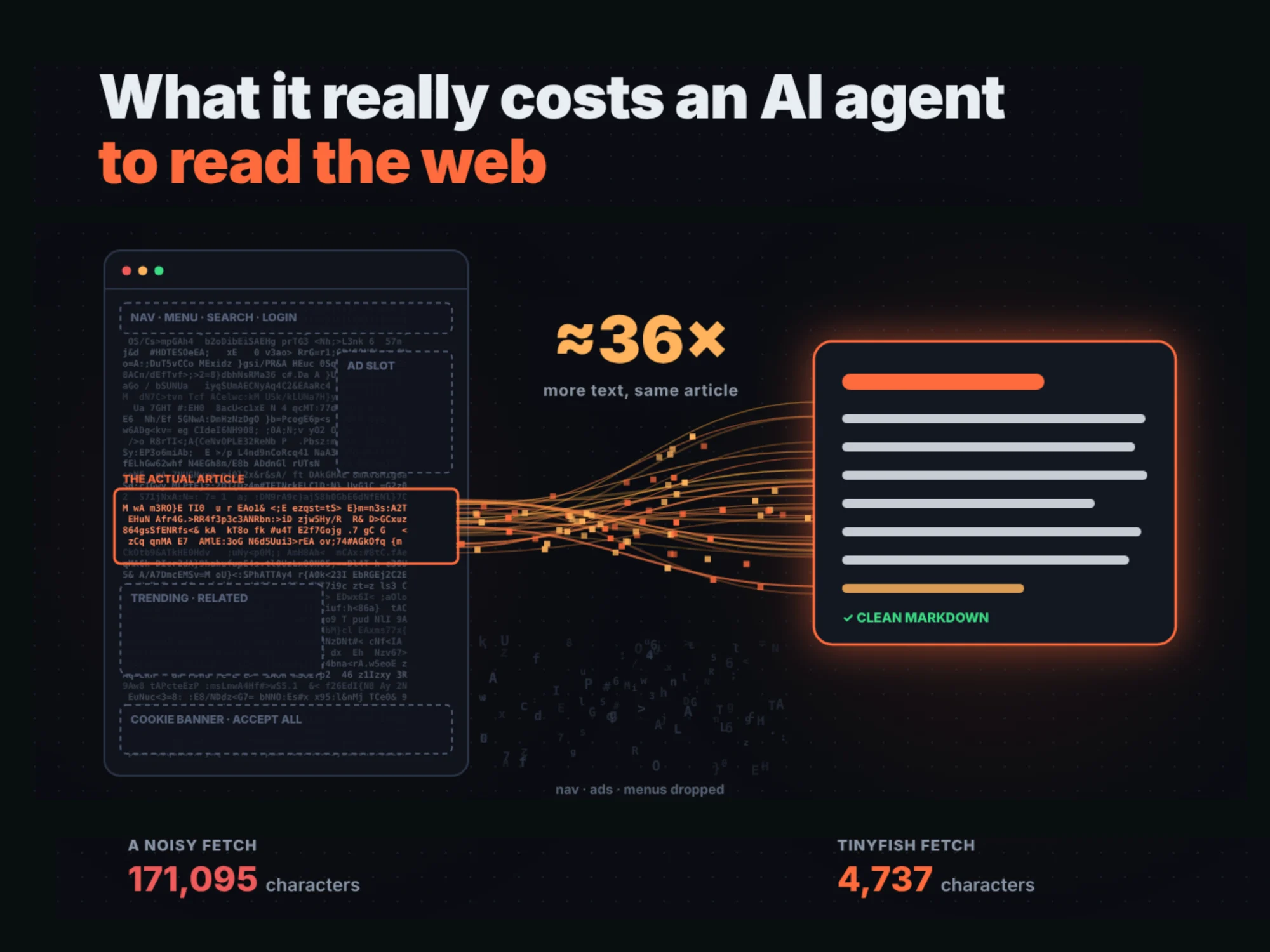
Az AI-ügynökök webes keresése kétfajta költséggel jár: a kereső API használati díjával és az átvett oldalak beolvasásakor keletkező tokenköltséggel. A TinyFish ingyenessé tette a keresési és letöltési API-ját bizonyos használati korlátok között, hogy az AI-fejlesztőknek ne kelljen a lekérdezésekért fizetniük.
A vállalat mérései szerint az egyes adatkinyerő szolgáltatások eltérő mennyiségű felesleges tartalmat adnak vissza. Egyetlen hírstikkel végzett teszt során a legbőbeszédűbb eszköz 36-szor több tokent fogyasztott, mint a leghatékonyabb kinyerési eljárás, ami gyorsan betöltheti a modellek kontextusablakát.
Az Artificial Analysis független mérésében a TinyFish Search érte el a legalacsonyabb teljes költséget, miközben a pontossági listán 71 pontos értékeléssel a mezőny végén végzett, és a válaszidőben is a lassabb rendszerek közé tartozott.
Az eredeti szöveg (MarkTechPost)
An AI agent that reads the web pays 2 kinds of cost. The first is the retrieval charge: what a search or fetch API bills per request. The second is model processing: content passed from retrieved pages into an AI model consumes tokens, while reasoning and generated responses add further costs. TinyFish , a web infrastructure company for AI agents, argues that teams budget for the model and underestimate how much retrieved content drives it.
This article walks through the token math, the context-window impact, and what the Artificial Analysis Search API leaderboard does and does not show.
TL;DR
What it runs on: TinyFish uses a web-native AI model designed for search, retrieval, and interaction with live websites. The model runs on TinyFish-managed infrastructure, while its cloud browser fleet renders pages and handles website interactions. No local GPU is needed. Access is via REST, Python and TypeScript SDKs, CLI or MCP.
Performance: On the Sep 28, 2026 Artificial Analysis snapshot, TinyFish Search (web) scores 71 at $9.30 per 1,000 benchmark tasks, with 59.0 seconds per task (model plus search time).
Best: $0 retrieval charge within rate limits (Search: 30 requests/min, 500/hour; Fetch: 150 URLs/min, 1,000/day), and the lowest total cost among the 12 configurations displayed on the leaderboard.
Trade-offs: The second longest time per task among displayed configurations, and an Agent product whose built-in model cannot be swapped.
Scores: Highest displayed is Perplexity Search (medium) at 80. Lowest displayed is TinyFish Search (web) at 71. The no-search baseline is 33.
Retrieval charges vs model processing costs
Search and fetch APIs usually bill per request or per page. Whatever they return then enters the model’s context and is billed as input tokens. Reasoning and output tokens come on top.
Enterprises now route each task to the cheapest capable model, a trend underlined when Stripe agreed to acquire OpenRouter , a gateway spanning 400+ models from 80+ providers. Routing lowers the price per token. It does not change how many tokens a retrieved page contains.
Free Search and Fetch remove TinyFish’s retrieval charge within its limits. The downstream model still incurs inference costs. That is why the size of each returned page matters.
How big is one page in tokens?
TinyFish ran a fetch quality evaluation on June 2, 2026, across 45 URLs and 5 providers on default settings. For one Daily Mail article with a body of roughly 4,300 characters, the providers returned:
Provider Characters returned Est. tokens* Input cost at $1 / 1M tokens* TinyFish Fetch 4,737 ~1,184 ~$0.00118 Exa Contents 65,793 ~16,448 ~$0.01645 Firecrawl Scrape 171,095 ~42,774 ~$0.04277 Tavily Extract 46,433 ~11,608 ~$0.01161 Parallel Extract 600 (excerpt, not the article) ~150 ~$0.00015
*Marktechpost calculation: ~4 characters per token and an illustrative input price of $1 per 1M tokens. Input processing only; excludes retrieval charges, reasoning and output. Real counts vary by tokenizer. Character counts from TinyFish’s evaluation.
In this example, Firecrawl returned approximately 36 times as many characters as TinyFish. Parallel also returned only an excerpt rather than the complete article, so its smaller output is not directly comparable to the full-page extractions.
While this illustrates how extraction output size can affect token consumption, the difference comes from a single webpage and should not be generalized across all websites. Those percentages are not used for this individual page comparison because outputs above 30,000 characters were truncated before judging.
Context limits and repeated calls
Assume every extracted character goes into the same context, with no filtering, truncation or summarization. A page containing approximately 42,774 tokens would consume about one-third of a 128K-token context window. Three such pages would require approximately 128,322 tokens, leaving little or no room for