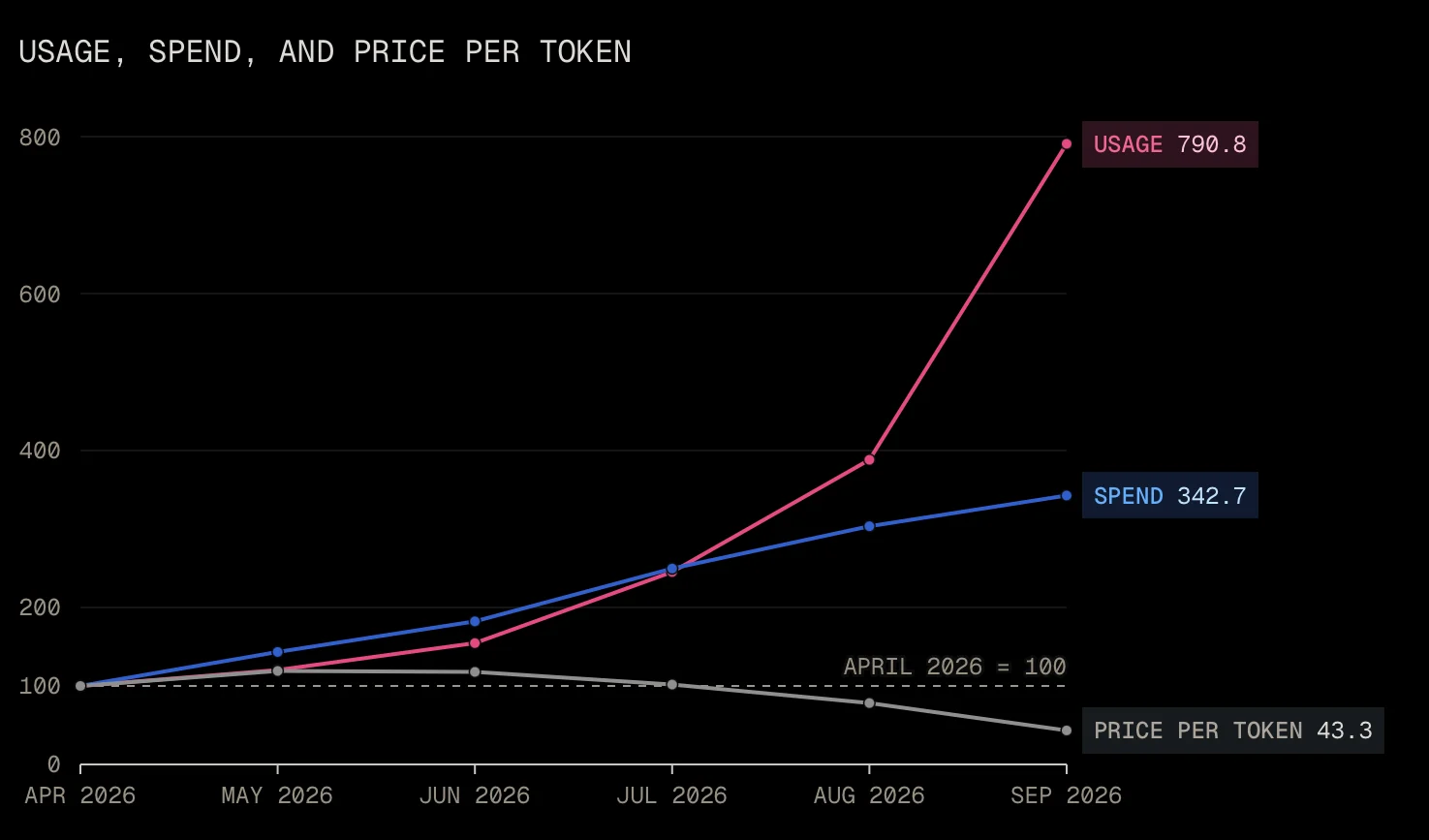
Max Woolf részletes elemzésben mutatta be, hogy az OpenAI és az Anthropic az elmúlt hónapokban agresszív árcsökkentési spirálba kezdett. Az OpenAI egyes modelleknél, mint a GPT-5.6 Luna, akár 80 százalékos engedményt is adott, míg az Anthropic a Claude-modelljeinek gyorsítótár-olvasási (cache read) költségeit vágta vissza jelentősen. A fejlesztések során a gyorsítótárazás díja kulcskérdés, mivel a kódolási és ügynökalapú folyamatokban a tokenhasználat döntő részét ez teszi ki.
A drasztikus áresés fő mozgatórugója a nyílt súlyú AI-modellek, mint a DeepSeek és a Kimi K3.1 Pro megjelenése. Mivel a felhős infrastruktúrák és a szolgáltatók között rendkívül egyszerűvé vált a váltás, a cégek kénytelenek lekövetni a piaci igényeket. A fejlesztők így jelentősen olcsóbban férhetnek hozzá a legújabb technológiákhoz, miközben a modellek teljesítménye nem romlott.
A piaci adatok szerint bár az egy tokenre jutó költség kevesebb mint felére esett vissza, a cégek összköltése mégis növekszik. Ez annak köszönhető, hogy a modellek képességei gyorsabban fejlődnek, mint amennyire az áruk csökken, így a felhasználók egyre több és komplexebb feladatot bíznak az AI-rendszerekre.
Az eredeti szöveg (Max Woolf's Blog)
pre code.language-txt,pre code.language-md{white-space:pre-wrap!important;word-break:normal!important}
Let’s look at a quick timeline of the major LLM model announcements from both OpenAI and Anthropic over the past few months. All pricing numbers provided are input MTok / output MTok / cache read MTok.
OpenAI announced GPT-5.6 Sol and Luna. Sol is the direct successor to GPT 5.5 at the same price of $5 / $30 / $0.50, while Luna is a small model specifically designed for cheaper use cases at $1 / $6 / $0.10. They also announced a Terra model that’s in between those two models, but few cared about it.
Anthropic announced Claude Sonnet 5, which Anthropic claimed to be closer to their Opus models, but feedback was mixed. Notably, it had launch pricing of $2 / $10 / $0.20 which was initially supposed to be temporary but would go up.
Anthropic announced Claude Opus 5, which was a long-awaited major-version update given the impact Opus 4.5 had on the rise of agentic coding, at a price of $5 / $25 / $0.50 (similar to GPT-5.6 Sol). Although some of the provided benchmark results surprisingly exceeded those of the much larger Fable 5, real-world feedback was more mixed.
OpenAI announces that they cut the price of GPT-5.6 Luna by 80% (???) to $0.20 / $1.20 / $0.02.
Model quality vs. Cost-per-task for GPT-5.6 Luna after the massive price reduction. Top-and-left is better, and if OpenAI didn’t do the 80% price cut, it would have lost to DeepSeek V4 Pro. via OpenAI
Anthropic announces the temporary Sonnet 5 price cut for the launch is now permanent.
OpenAI announces that they are cutting the price for GPT-5.6 Sol by ~20% ($4 / $20 / $0.40) for the next three months.
Anthropic announced Fable 5.1 at a price of $10 / $50 / $0.25, which, in addition to having strictly better benchmark performance in all areas than Fable 5 from June at $10 / $50 / $1, cut the cache read cost by 75%.
When using agents for coding, cache read costs are the vast majority (96% - 99%) of the total token expenditure as the cache is what contains the entire previous conversation each turn. Additionally, the cache tends to be hit around 90 - 100% of the time (varies by the infrastructure of the LLM inference provider). Taken together, a 75% reduction in the cache read cost correlates to a 70-75% reduction in the cost of using the model—obviously notable, even if cache costs are typically a footnote!
OpenAI announced GPT-6 Astra, which is similar in size to Fable 5.1 and has similar pricing at $10 / $50 / $1 but without the lower cache read cost. Astra’s model performance is indeed comparable to Fable.
OpenAI announced GPT-6 Sol at at a shocking price of $2 / $10 / $0.20 that halves the input and output price relative to the temporarily-discounted GPT-5.6 Sol! They simultaneously released GPT-6 Luna also at half the input and output price ($0.10 / $0.50 / $0.01) of the previous version.
On the same exact day, Anthropic announced Claude Opus 5.5, where it’s explicitly stated “Opus 5.5 requires less compute to serve than Opus 5, and its pricing reflects that”. Its price of $4 / $20 / $0.20 is much lower in total than Opus 5’s due to a 20% input/output cost cut and a larger cache read cut, resulting in a total cost reduction of 40-60% for a model that’s even better than Fable 5.1 (I have quite a lot of things to say about Opus 5.5, but that’s for another post).
It turned out that GPT-6 Sol was a dud performancewise, so a week later OpenAI announced GPT-6.1 Sol, which surprisingly has comparable performance to Astra (can confirm after personal use), but OpenAI casually cut the cache price in half ($2 / $10 / $0.10) matching Anthropic’s 5%-of-input cache read cost, making this model family cumulatively 75% cheaper.
Overall, starting from the release of the GPT-5.6 model families in June to now, the cost of using these popular LLMs has cratered, which is not something I would have expected a year ago. These price cuts also apply to model usage from subscription