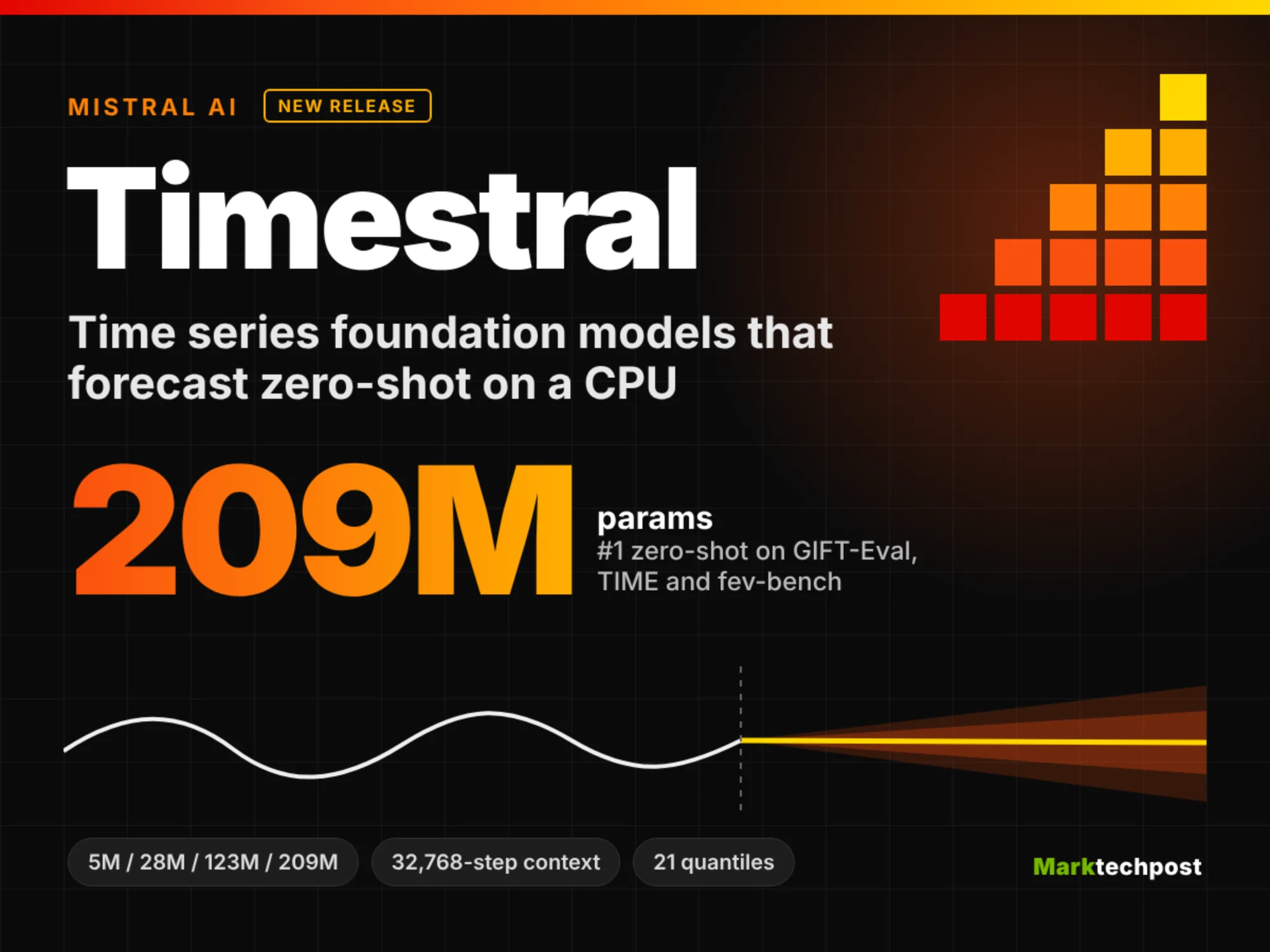
A Mistral AI bemutatta a Timestral modellsorozatot, amely 4 különböző méretű (5M és 209M paraméter közötti) idősor-előrejelző modellből áll. Az eszközök nyílt súlyokkal, módosított MIT licenc alatt érhetők el, és felhős infrastruktúra helyett normál szerver-CPU-kon is gyorsan futtathatók. A legnagyobb, 209 milliós paraméterszámú modell GPU nélkül mindössze 140 milliszekundum alatt készít előrejelzést.
A rendszer a klasszikus statisztikai eszközökkel szemben nem teszi szükségessé a nulláról való betanítást minden egyes adatsoron, hanem a mintázatokat tartományok között viszi át. A modell támogatja a többváltozós adatokat, a külső tényezőket és az akár 32 768 időlépéses kontextust is. A mérések alapján a nulla mintás előrejelzési teszteken felülmúlja a Google TimesFM-3 modelljét.
A fejlesztők a GitHubon keresztül vagy a Hugging Face felületéről tölthetik le a modelleket Python környezetbe. A cégek a saját adataikra szabott finomhangolást a Mistral Forge felületén végezhetik el, és akár teljesen zárt, helyi infrastruktúrán is üzemeltethetik azt.
Az eredeti szöveg (MarkTechPost)
Mistral AI has released Timestral , its first family of time series foundation models. Timestral is a set of 4 zero-shot forecasting models from Mistral AI, sized from 5M to 209M parameters. The largest checkpoint ranks first among pretrained, zero-shot models on GIFT-Eval, TIME and fev-bench. It does this without a GPU at inference. For developers, this Timestral time series foundation model means probabilistic forecasts on standard server CPUs, with open weights and inference code .
TL;DR
Size: 4 models: 5M, 28M, 123M, 209M parameters (dense). Context up to 32,768 time steps.
Runs on: Standard server CPU, no GPU needed. 209M weights are 837 MB in fp32. GPU optional.
Performance: #1 among zero-shot pretrained models on GIFT-Eval, TIME and fev-bench (Mistral-reported).
Best: fev-bench SQL skill score of 50.39, ahead of TimesFM-3 at 48.99.
Worst: GIFT-Eval MASE of 0.658 leads t0-gamma (0.661) by only 0.003.
What is Timestral?
Timestral is a time series foundation model (TSFM). It is pretrained on a large, diverse corpus, then forecasts zero-shot on data it has never seen. Classical tools like ARIMA fit one series at a time. Deep models like PatchTST usually train from scratch on each dataset. Timestral transfers patterns across domains instead.
Each model outputs 21 quantiles per time step . It forecasts multivariate targets jointly. It accepts past-only, known-future and categorical covariates.
How does Timestral work?
Timestral is a causal, patch-based transformer with time attention and variate attention. The 209M model uses 24 layers and an embedding dimension of 768 . Each patch covers 32 time steps. A single forward pass forecasts up to 1,024 steps. Longer horizons run block by block, feeding each block’s median back as context.
Mistral lists 4 technical contributions :
Decoupled Horizon Forecasting (DHF): Learned forecast tokens read the full history. Observed values stay in context instead of being masked, unlike contiguous patch masking in Toto 2.0 and TimesFM-3.
Covariate-aware attention: Each series is a target, past-only covariate or known-future covariate. Information flows only from covariates to targets, preventing future leakage.
Synthetic-first data: Most training data is synthetic, with trends, seasonality, noise and nonlinear cross-series dependencies.
Two-stage training: Pretraining on synthetic data at context 8,192, then post-training on mixed data with 4x longer context. The loss is pinball loss over 21 quantiles.
How does Timestral perform on benchmarks?
All scores below are zero-shot, from a single checkpoint without ensembling. They come from the Timestral-209M model card .
GIFT-Eval: MASE 0.658, CRPS 0.446 (lower is better).
TIME: MASE 0.626, CRPS 0.522 (lower is better).
fev-bench: SQL skill score 50.39, MASE skill score 39.49 (higher is better).
The size scaling is flat at the top. Timestral-123M scores 0.659 MASE on GIFT-Eval , against 0.658 for 209M. Mistral team states that the 28M model beats Chronos-2 on GIFT-Eval and TIME. Chronos-2 is about 4 times larger.
How fast is Timestral on CPU?
Mistral team tested a standard server CPU with 8 threads. The task: forecast 1 day ahead from 3 weeks of 15-minute history. The 5M model took 10 ms and the 209M model took 140 ms . The 28M model is 5 times faster than 209M. The 123M model lands within 0.2% of the 209M score at three quarters of its latency.
How does Timestral compare with TimesFM-3, Chronos-2 and Toto 2.0?
Feature Timestral-209M TimesFM-3 Chronos-2 Toto-2.0-2.5B Developer Mistral AI Google Research Amazon Datadog Parameters 209M 330M 120M 2.5B Architecture Causal patch transformer, DHF Decoder-only, contiguous patch masking Encoder-only, group attention Decoder-only, contiguous patch masking Max context 32,768 steps Not disclosed 8,192 steps Not disclosed Single-pass horizon 1,024 steps Not disclosed 1,024 steps (max) Not disclosed Quantiles 21 9 Not disclosed 9 Weights licence Modified