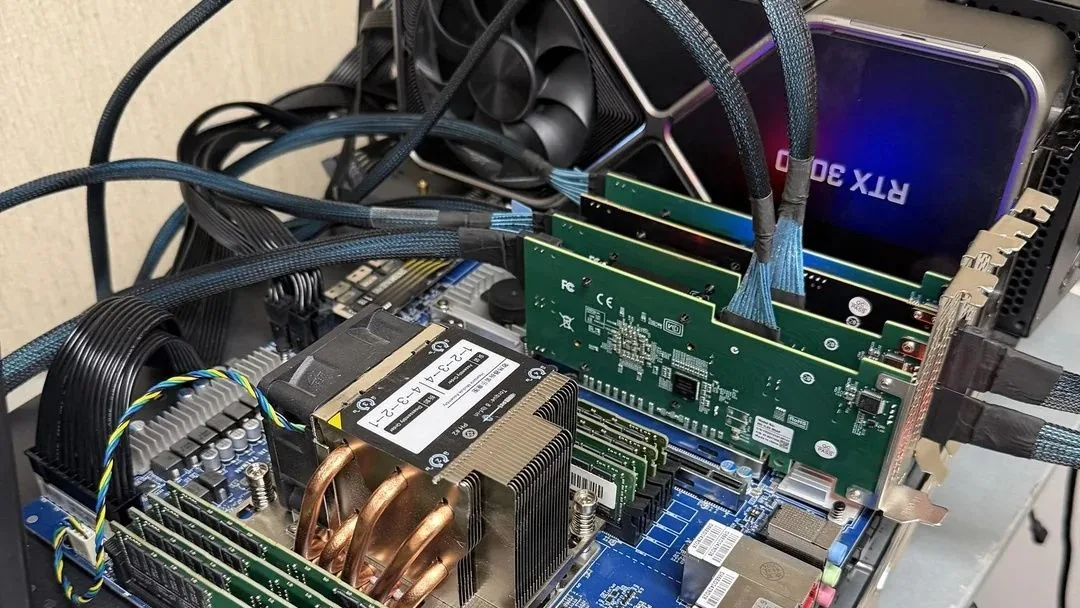
Egy dél-karolinai ügyvéd, Nick Mermiges egyedi, 8 darab használt Nvidia V100 videókártyára épülő AI-szerverét bővítette 1 TB RAM-mal és egy RTX 3090 GPU-val. A rendszert arra használja, hogy a DeepSeek V4.1 Flash modellt saját, kifejezetten jogi feladatokra fejlesztett ellenőrző kódjával ötvözve futtassa az irodáján belül.
A fejlesztés során a modell által használt szakértői modulok csaknem 40 százalékát sikerült 2-bites pontosságról 4-bites NVFP4 precizitásra emelni. Ez lényegesen jobb válaszminőséget eredményez, mivel a modell lekéréseinek több mint 80 százalékát a pontosabb szakértői rétegek szolgálják ki.
A finomhangolási és kódolási munkát Claude Code segítségével végezte el. A szerver átlagos generálási sebessége másodpercenként 150-180 token, és a gépen a bizalmas ügyféladatok végig helyi hálózaton, az iroda elhagyása nélkül maradnak.
Az eredeti szöveg (Tom's Hardware)
A lawyer with a private AI server built on eight used Nvidia V100 GPUs returned with an update, moving about 80% of its work up from 2-bit to 4-bit NVFP4 precision and bringing in 1TB of RAM and an RTX 3090. The server uses DeepSeek V4.1 Flash with a legal harness, the workflows and checks he wraps around the model, for his law practice. The cost? Performance, with code output dropping from 160–215 to 150–180 tokens per second, although the crashes that hit the new build are gone. The culprit behind the crashes, originally blamed on PCIe, was likely a bad PSU.
Once a random hardware nerd lawyer on Reddit, the lawyer's responses to the original breaking story illuminated his identity. He’s a trial lawyer in Columbia, South Carolina. ProprietaryLegalAI commented on our first story three times, linking to a code repository, site, and LinkedIn that identify him as Nick Mermiges, founder of PLI Labs and proprietarylegal.ai. His other firm, PLI, is a technology consultancy, not a law firm, and now lists private, on-prem LLM serving as a service.
He built the software side with AI, specifically Claude Code, which wrote the kernels and ran the benchmarks with his direction. The Opus 5.5 and Fable 5.2 models handled the optimizations, custom kernels, and re-quantizing; he noted he was surprised at how well Fable built custom Volta kernels, and how it re-quantizes the experts his legal harness triggers. From about February to July, he built a legal harness around Claude that worked, while his attempts at a local-model version failed, but then DeepSeek V4.1 Flash arrived, and he was able to port it successfully, even if he says it’s not as good as frontier.
He reaffirms that “the documents never leave the office” and upgraded the system from 256GB to 1TB of RAM and tossed in a newer GPU, even as the V100s stay on “borrowed time” with R580, the last Nvidia driver branch to support them. The project’s intentions, as listed last time, suggested he wanted the system to be able to offload more of his workload, so this and the precision change are a reasonable upgrade. His previously stated goal of wanting the system to handle more than one request at a time has also been met.
The original “Volta sPLIt” build we covered has transformed into the “Volta Max uPLIft,” still with the clever lettering as his company’s initials are PLI — Proprietary Legal Intelligence. He now claims “near-NVFP4 precision,” having described NVFP4 on our forum earlier this week as “essentially full precision.” NVFP4 is Nvidia’s 4-bit floating-point format, and Nvidia publishes its own NVFP4 version of DeepSeek V4.1 Flash; the project’s README says that version matches the precision of the model’s official weights at 4.25 bits per weight.
DeepSeek V4.1 Flash is built from “experts,” the parts of the model that do most of the work for each word. This model didn’t fit at that precision before, as 384 routed experts, in each of 40 layers, counts to 15,360 in all. At official precision, this comes out to about 269 GiB, by his estimate, and eight 32GB V100s have 256 GiB in total before anything else is loaded. With the 2-bit build, the weights were 248.8GB; the new build’s Hugging Face package is about 556GB.
The workaround is to keep every expert on the cards at 2-bit and swap the most-used ones up until the cards are full, which in this case came out to about 38.7%, or 5,949 experts, at precisely NVFP4. “Most-used,” in this context, refers to a count from a mix of four kinds of text, which are weighted equally, one of which is his own legal harness traffic.
Get Tom's Hardware's best news and in-depth reviews, straight to your inbox.
The payoff is that those experts do most of the work. In testing with one request at a time, between 80% and 86% of decode routes, the calls to an expert made while the model writes, land on the NVFP4 experts, lowest for general text and highest for source code. The prediction for the two-request setup he runs is 78% to 85%. The remaini