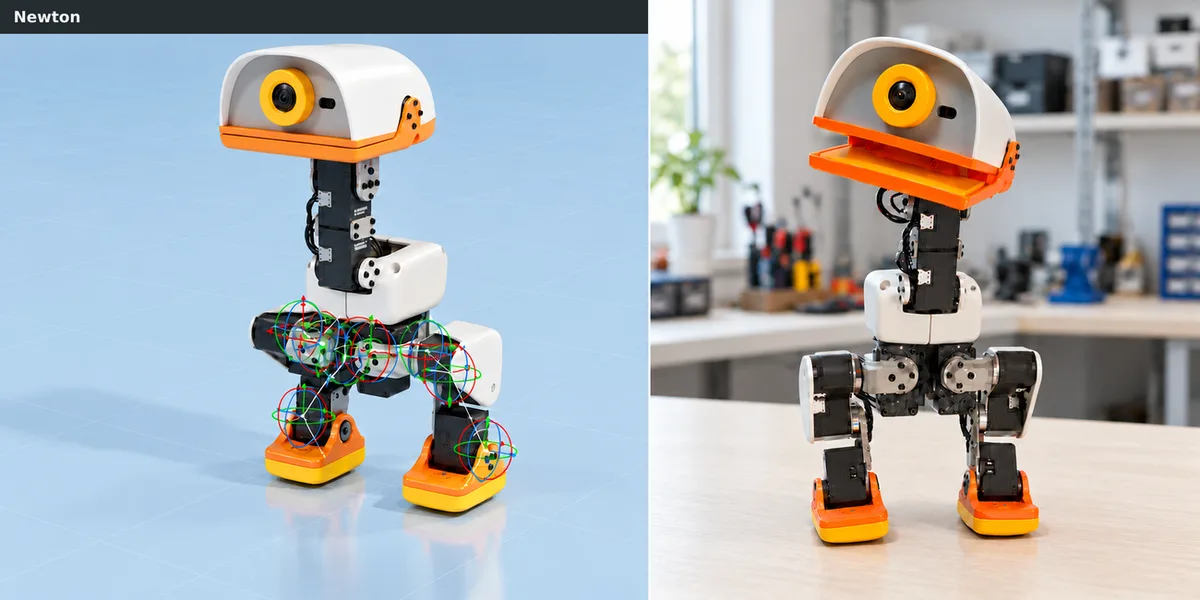
A Pollen Robotics és a Hugging Face által kiadott Microduck egy nyílt forráskódú, megfizethető kétlábú robot. Az NVIDIA Isaac Lab 3.0 és a Newton fizikai szimulációs keretrendszer segítségével a fejlesztők GPU-n párhuzamosított környezetben taníthatják meg a robotot járni, majd az elkészült modellt ONNX formátumban exportálva közvetlenül a fizikai hardverre telepíthetik.
A szimulációs oktatás során domain randomizációt és specifikus aktuátormodellezést alkalmaznak, így a modell felkészül a valós fizikai kihívásokra. A rendszer figyelembe veszi a szervómotorok késleltetését, a súrlódást, a váltó mechanikai holtjátékát (backlash), valamint a talaj egyenetlenségeit és a külső lökésrohamokat is.
Az elkészült modellek megoszthatók a Hugging Face Hubon, és a Microduck Arena virtuális kihívásaiban is összemérhetők. A tanítási munkafolyamat a sima felületi járástól a nehéz terepen és emelkedőkön való haladásig terjed.
Az eredeti szöveg (Hugging Face)
This post was written in collaboration with Antoine Pirrone, Augustin Crampette, Matthieu Lapeyre, Coralie Deplanne, Anne-Charlotte Passanisi, and Thomas Wolf.
Microduck is a newly released affordable open-source bipedal robot by Pollen Robotics and Hugging Face. And now you can train Microduck to walk with Isaac Lab and Newton. Test the policy, export it as ONNX, and deploy it on the real robot. Share it on the Hugging Face Hub or validate it for competition in Microduck Arena, then explore more advanced tasks with NVIDIA Isaac Lab.
A walking policy trained in simulation must also handle the friction, delays, and mechanical play of real robot servos.. NVIDIA Isaac Lab is an open-source framework for training policies across thousands of GPU-parallel simulations. With Newton, actuator modeling, and domain randomization, developers can prepare policies for real hardware. Microduck brings this workflow to life: train a walking policy in simulation, export it as ONNX, and deploy it on a real biped robot.
This tutorial walks you through training and evaluating Microduck with Isaac Lab and Newton, then exporting the policy for deployment. From there, you can share your model on the Hugging Face Hub, test its compatibility and compete in Microduck Arena, or put it to work on your own Microduck. Walking is the starting point—with linked examples to help you explore more of Isaac Lab 3.0.
For the simulation and training portion, you’ll need:
A Linux workstation with a supported NVIDIA GPU and driver. See requirements.
Its onboard robot software is installed and working.
A supported control interface, such as a paired gamepad.
On Linux with a supported NVIDIA GPU and driver, install uv (skip the first two lines if it is already available), clone Isaac Lab, and install its dependencies:
Confirm that the Microduck tasks and presets are available:
Isaac Lab already provides Microduck’s robot model, scene, observations, actions, rewards, and domain randomization. Start with the flat-walking task; the rough variant adds stairs, slopes, and uneven terrain.
Figure 2. Microduck environments side by side: flat terrain (left) and uneven terrain (right).
The policy takes 61 observation values and outputs 14 joint-positions. Keep the observation order, normalization, and action scaling consistent when exporting and deploying. See the Microduck task configuration for the full observations, rewards, and simulation settings.
Isaac Lab accelerates Microduck locomotion training by running simulated environments in parallel on the GPU. Isaac Lab can also run distributed training across GPUs, for instance training with 16 GPUs to speed-up the training and increase robustness. In this configuration, we can reach up to 1.25M steps per seconds with rough terrain and backlash enabled.
In this tutorial, we use Newton with the MJWarp solver and Newton-based Better Actuator Models (BAM) to model servo response, together with the backlash preset to turn position targets into realistic servo torques by modelling the firmware controller, motor electrical limits, friction and delay. To allow the policy to transfer from simulation, we make use of domain randomization. On each duck we randomize the mass/centre of mass, ground friction, joint inertia, encoder offsets, battery voltage/sag and command latency. We also vary terrain and apply pushes; as well as backlash independently per joint to represent uneven wear.
Backlash is the mechanical play in a gearbox, when a joint changes direction, the transmission can move slightly before engaging. Modeling this effect and varying it across joints during training exposes the policy to differences it may encounter on the real robot.
We used the rough terrain for deployment but alternatively you can train the flat terrain environment with this command:
To deploy a Microduck walking policy on the physical robot, export it to ONNX after evaluating it in simulation. Isaac Lab’s RSL-RL playback workflow automatic